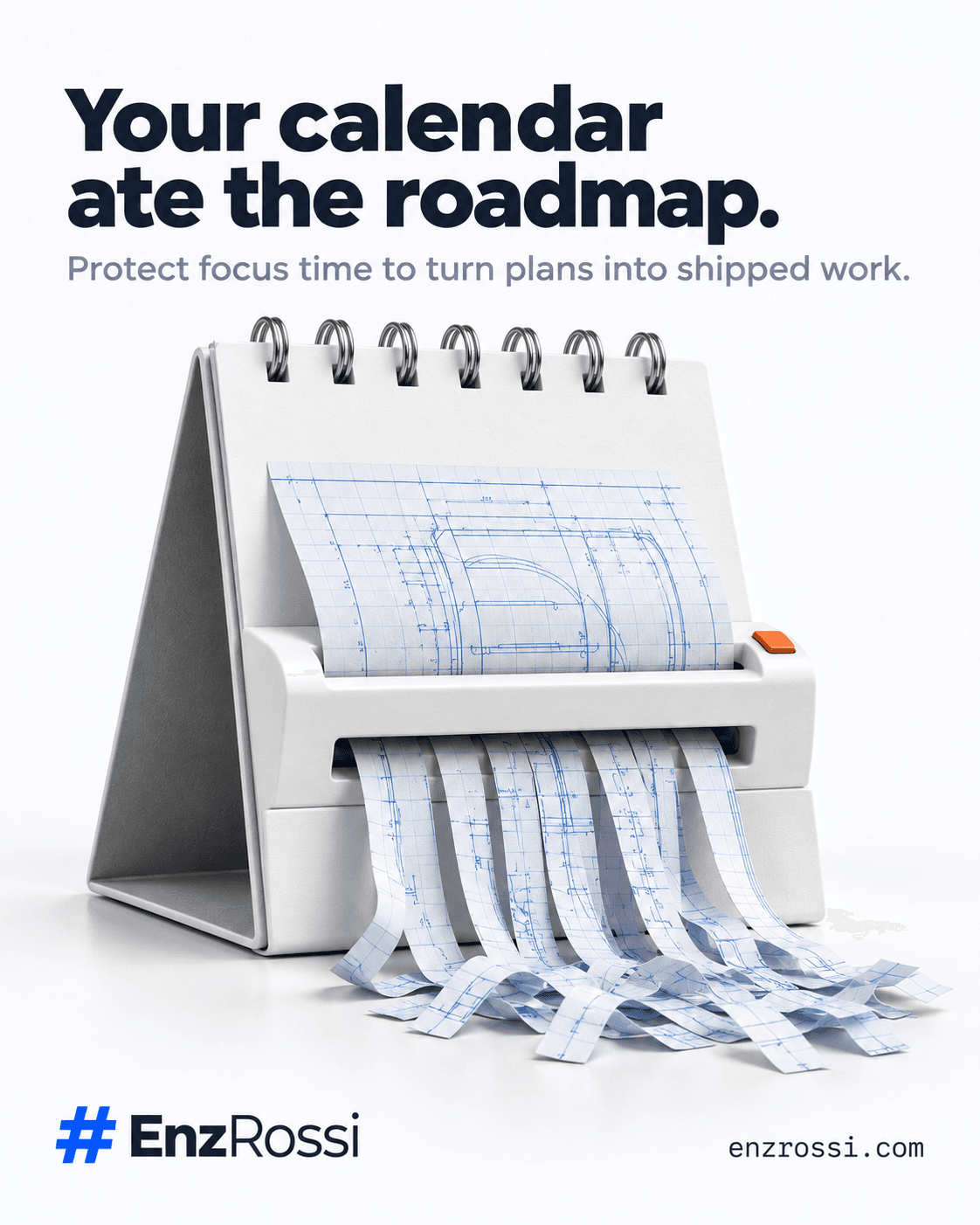
A calendar can make a team look fully utilized while leaving important work unfinished. Each meeting has a reason. Together, they may leave no useful stretch of time to understand a difficult problem, build a change, and check whether it works.
The calendar shredding a roadmap is a visual exaggeration. The management decision is concrete: when you approve a delivery plan, have you also protected time in which delivery can happen?
Look at the shape of time
Total meeting hours tell only part of the story. Three conversations grouped into one working window leave a different day from the same conversations scattered between short gaps. Ask engineers which blocks are genuinely usable, where they repeatedly restart, and which decisions need live discussion.
Avoid interpreting every interruption as waste. An urgent customer incident or a short clarification may prevent much larger rework. The goal is to distinguish valuable coordination from meetings that survive because nobody has revisited their purpose.
Start with one team's calendar rather than announcing a company-wide ban. Include the people who depend on that team so that protecting focus does not quietly move delays elsewhere.
Use research as context, not a diagnosis
Microsoft's 2025 analysis of the infinite workday reported that 52% of surveyed leaders described work as chaotic and fragmented. This describes respondents in that research; it is not a measurement of your engineers or proof that any particular meeting should disappear.
Your own evidence should connect working patterns with delivery. Look at blocked work, decisions waiting for answers, after-hours catch-up, and whether people can complete meaningful tasks during their agreed working day.
Run a bounded calendar experiment
Choose a short trial period and a narrow change. Move one routine status meeting into a written update that states progress, next steps, and decisions needed. Keep a route for urgent issues. Group predictable cross-team decisions into a shared window, and reserve a daily focus block when practical.
Name the person who checks that written questions receive answers. Otherwise an asynchronous update can become a quieter version of the same delay. Tell stakeholders when they can expect a response and which situations justify interrupting the protected block.
At the review, ask whether useful work moved forward, whether quality remained acceptable, and whether coordination became harder. A calendar with fewer meetings is not success if decisions now take longer.
Make working overlap purposeful
Distributed teams need overlap for collaboration, especially when uncertainty is high. They also need protected time outside that window. With LATAM engineers working alongside US teams, agree on both: the shared period for decisions and the conditions for uninterrupted work.
EnzRossi supports engineering teams with senior talent, product and QA expertise, and technical leadership. Discuss the capacity and collaboration your roadmap needs. Hiring expertise is only part of the plan; giving that expertise room to work is a leadership responsibility.