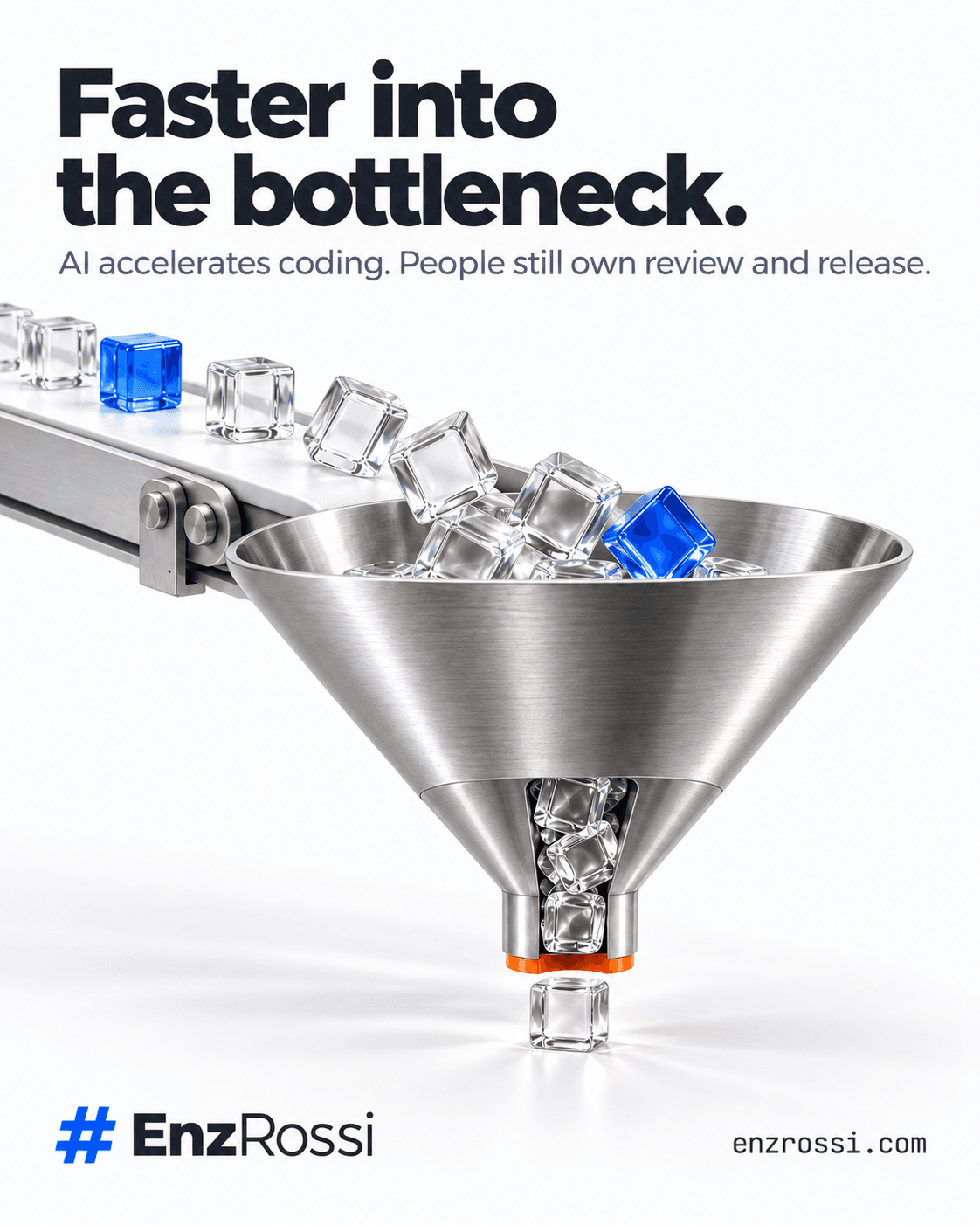
Your team can produce a change quickly and still take a long time to deliver it. The difference lives between the keyboard and the customer: reviews, test environments, decisions, release coordination, and work that nobody can move forward alone.
That is the management question behind the funnel in our illustration. The picture is fictional. The situation is familiar enough to investigate without assuming that every delay needs another developer or another AI subscription.
Follow one change all the way through
Choose a recently delivered feature. Reconstruct when someone started it, when it first became reviewable, when review finished, and when a customer could use it. Record waiting separately from active work. Include the return trips: a missing requirement, a failed test, or a reviewer discovering an assumption after implementation.
The aim is a conversation about the system. A timeline used to rank individual engineers will encourage people to protect their numbers. Ask what prevented the next step and what authority or information would have removed the obstacle.
For example, imagine an engineer finishes a draft on Tuesday morning but needs an architectural decision from someone available on Thursday. Faster drafting creates a longer-looking review queue without changing the decision date. That example is illustrative, not a measured EnzRossi client result.
Treat AI as part of the workflow
DORA's 2025 report describes AI as amplifying existing organizational strengths and weaknesses. It supports looking beyond tool access to the environment in which people work. It does not promise that a specific practice will create a particular delivery improvement.
Our practical recommendation is to evaluate an AI-assisted task through acceptance. Include review, correction, testing, and the context needed by the next person. Keep useful improvements even when the benefit appears as better exploration or clearer tests rather than an earlier release.
Choose an intervention that matches the delay
If work waits for a decision, name an owner and make the decision boundary explicit. If reviews wait for one specialist, examine whether the team needs shared knowledge, smaller changes, or additional senior review capacity. If requirements keep changing, involve product and engineering earlier rather than treating every rewrite as an execution problem.
Change one manageable part of the process first. Record the expected effect, the observation window, and a quality measure that must not deteriorate. An apparently shorter cycle achieved by deferring defects is a different outcome from reliable delivery.
Write a better capacity brief
A useful brief says what the team must deliver, where work currently waits, and which responsibility a new person would own. It can lead to staff augmentation, QA support, product leadership, or a dedicated cross-functional team. Sometimes it leads to changing the decision process before hiring.
EnzRossi helps US companies build engineering capacity with senior LATAM talent, technical and soft-skill screening, and continuous AI training. Start with the work your team cannot move forward. The right discussion begins with the constraint, not with a promise that more code will solve it.