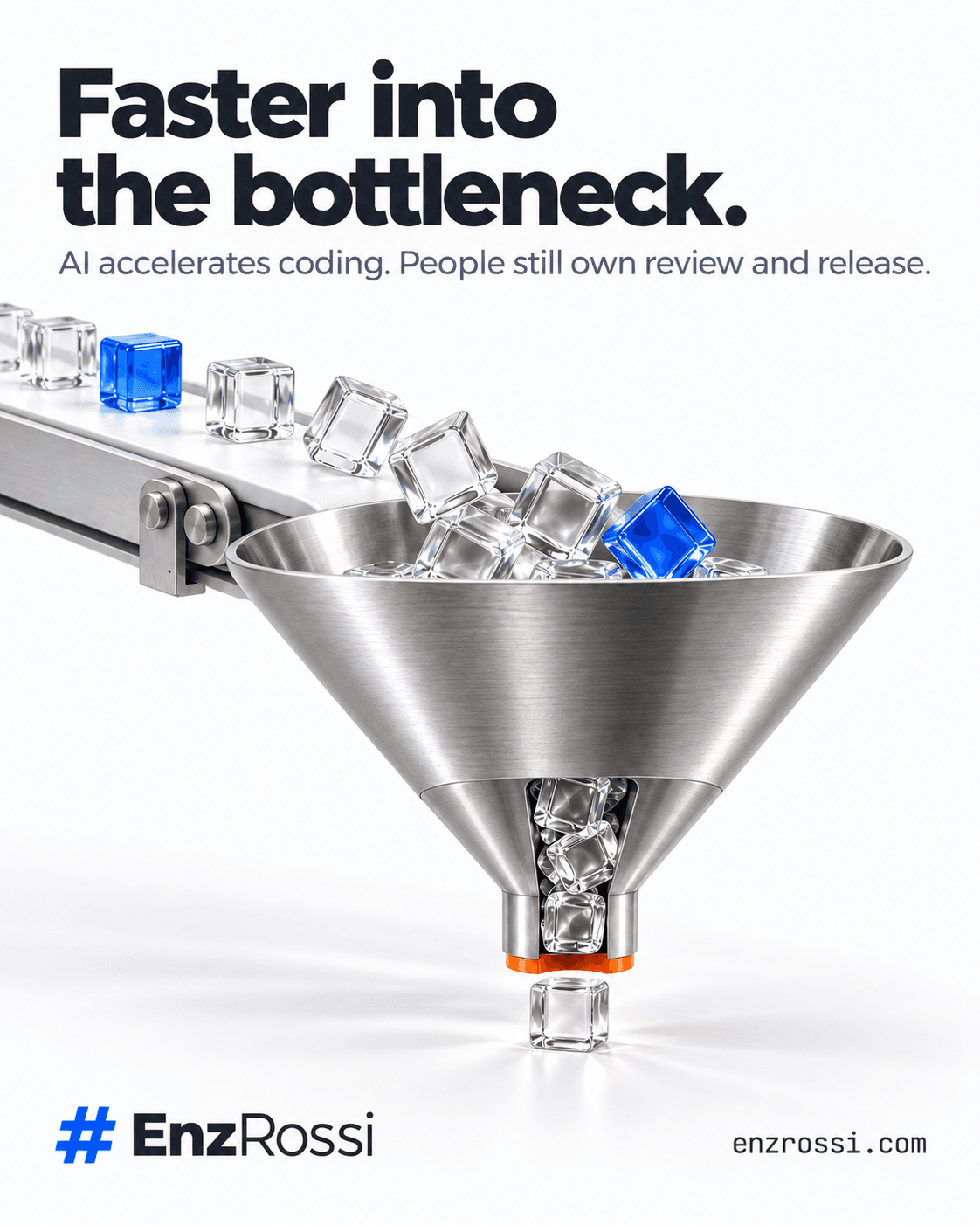
“The AI wrote it” describes where a draft came from. It does not explain why the change meets the requirement, handles failure, or deserves to reach customers. Managers do not need to inspect every line themselves, but they do need a clear answer to who makes that judgment.
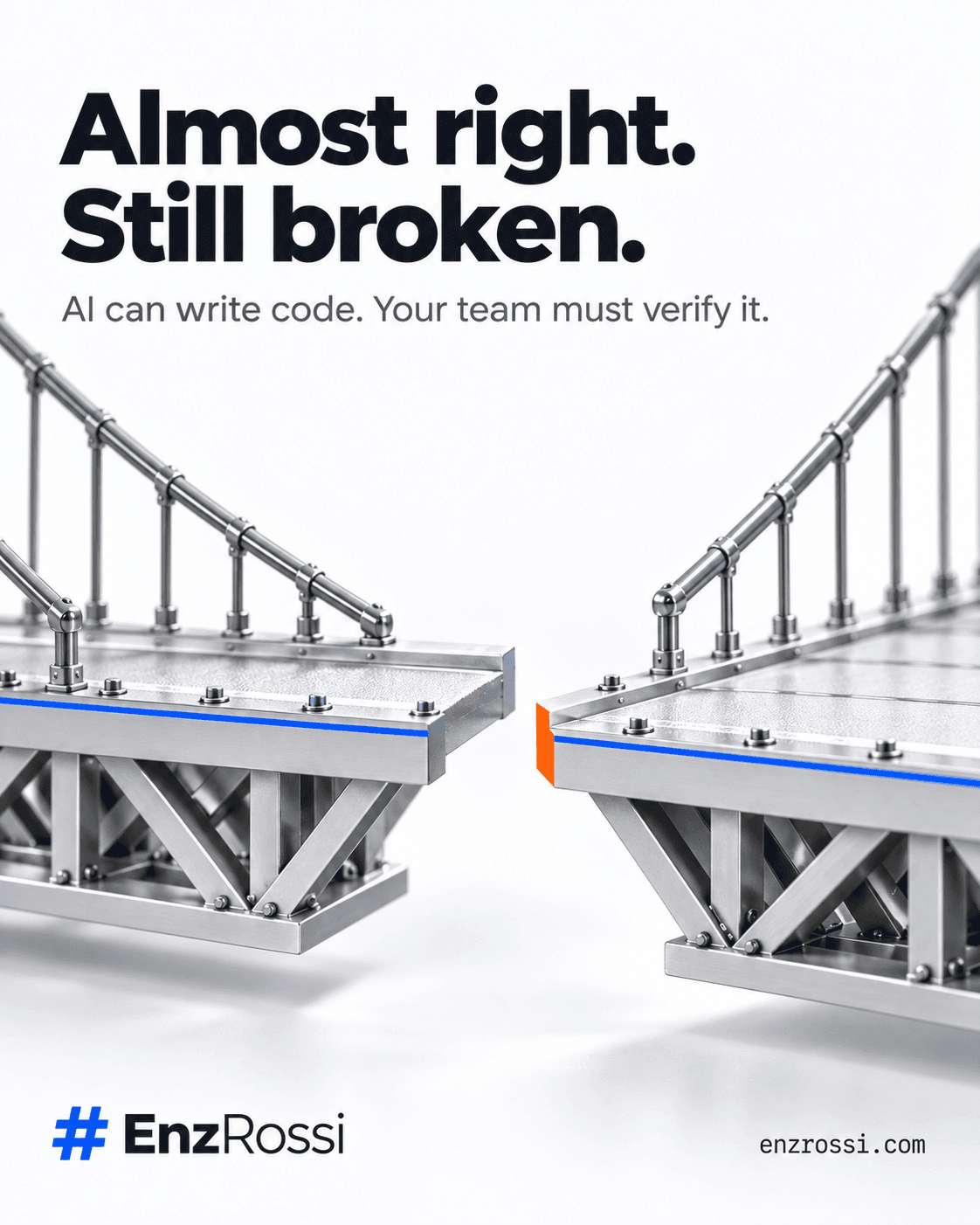
The almost-connected bridge in our image illustrates a useful distinction. Something can look close to finished while still failing at the point that matters. In software, the missing connection may be a misunderstood requirement rather than an obvious syntax error.
Confidence and correctness are different measures
The 2025 Stack Overflow Developer Survey reported 46% distrusting AI output accuracy and 33% trusting it among respondents to that question. Those figures measure reported confidence. They do not mean 46% of generated code is defective, and they are not a representative assessment of every engineering team.
For an individual change, evidence has to come from the work. Can the engineer explain the approach? Do tests challenge the behavior that matters? Has someone considered the failure cases and the context the tool might not know?
A polished explanation can be a useful starting point. It should not replace independent checking. The same principle applies when a confident human wrote the first draft.
Define what acceptance requires
Start with the expected behavior and the consequence of failure. A change affecting access control deserves different scrutiny from a small internal presentation change. The review should match the risk and the organization's requirements, rather than depend only on whether AI was involved.
Ask the author to explain assumptions, identify uncertainties, and describe how the change was checked. A reviewer should be able to follow that reasoning without reconstructing an entire private conversation with a tool.
Include operational questions where relevant: how the team will notice a failure, who responds, and whether the change can be reversed. Passing a test suite is one piece of evidence; the team must still understand what the suite does not cover.
Give reviewers capacity to exercise judgment
A review policy cannot create time or experience. If every difficult change goes to one senior engineer, examine the volume of incoming work and the support available. Smaller reviewable changes, better context, stronger test ownership, or another experienced reviewer may help.
Treat training as practice in evaluating real examples. Ask engineers to find weaknesses in a plausible generated answer and explain what evidence would resolve them. Avoid rewarding speed alone when the role also requires careful judgment.
Hire for explanation as well as execution
EnzRossi screens technical and soft skills because software work includes communicating uncertainty, responding to challenge, and collaborating on difficult decisions. We can support teams with senior engineering, QA, and technical leadership.
Talk with us about the responsibility your team needs help carrying. The objective is a workflow in which somebody can explain why a change is ready, with evidence that survives beyond the prompt.